
Every volleyball coach knows the frustration of watching their team get stuck in a rotation, giving away point after point. But what if you could identify those weaknesses before they cost you a match?
A team might finish a set with decent overall statistics while consistently struggling in one particular rotation. When performance is averaged across all six rotations, these weaknesses can easily go unnoticed.
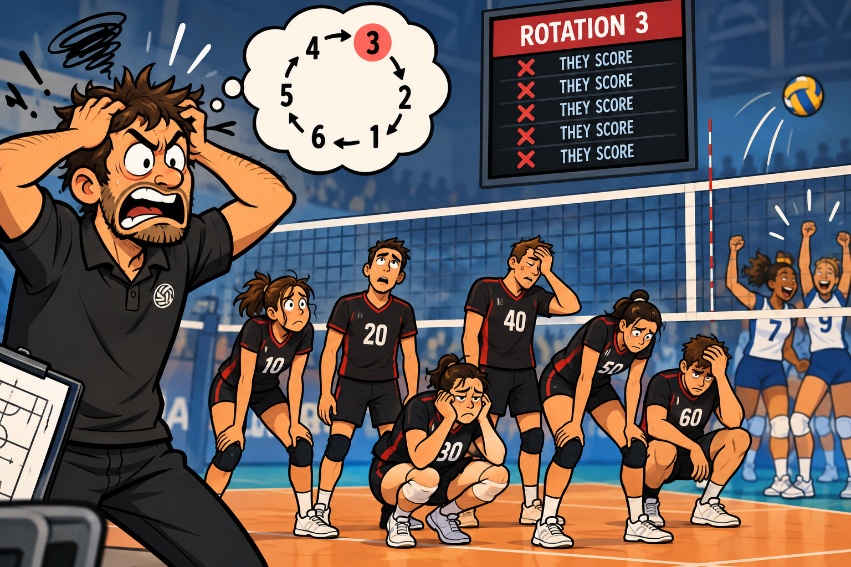
Tracking performance by rotation helps coaches identify where their team struggles, understand why, and make targeted adjustments. During matches, this information can guide tactical decisions. In training, it helps coaches focus on the situations that need the most improvement.
Why Stats by Rotation Matter
Each rotation changes the players’ court positions, front-row attackers, setter location, serve-receive responsibilities, blocking matchups, and available substitutions. Because the conditions change, team performance can change too. A single match total cannot show whether one particular rotation is responsible for a large share of the team’s errors or scoring runs.
Looking at points, errors, and skill ratings within each rotation helps answer practical questions:
- Which rotations score consistently, and which ones lose points?
- Is a weak rotation struggling in reception, setting, attack, blocking, defense, or serving?
- Does the problem appear against a particular opponent rotation or front-row matchup?
- Is the same pattern recurring across sets or matches?
Use the Information During the Match
I’ve won several matches simply by adjusting our starting rotation between sets based on what happened in the previous one. Sometimes, shifting our lineup by two or three rotations was enough to create better attacking matchups, such as positioning our strongest hitters against the opponent’s weakest blockers.
That’s why tracking both your team’s rotations and your opponent’s is so valuable. Volleyball is a bit like chess: understanding the matchups allows you to position your players strategically and exploit weaknesses.
But rotation data isn’t just about choosing where to start a set. It can also help you make adjustments in real time.
If your team keeps losing points in a particular rotation, look at what’s causing the problem. Depending on the situation, you might adjust the serve-receive formation, change attacking options, target a different receiver when serving, or make a substitution.
The goal is simple: identify problems before they turn into long scoring runs and use favorable matchups to your advantage.
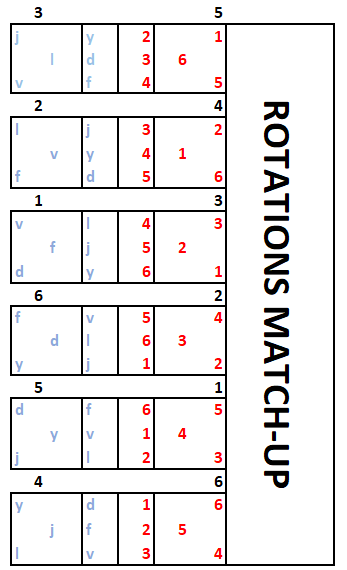
How to Track the Matchups
- Record the starting lineups. Write down where each player is positioned on both sides of the net at the beginning of the set.
- Map the remaining rotations. Move each player one position clockwise to complete the six rotations for both teams.
- Identify the matchups. Compare which hitters face which blockers in each rotation, and look for favorable or unfavorable matchups.
Coaching tip: Keep this chart handy during matches. Use it to identify attacking opportunities, anticipate difficult rotations, and adjust your starting lineup between sets to create more favorable matchups.
Turn Match Data Into Better Training
After the match, the weakest rotation gives the staff a clear place to begin. Instead of scheduling a broad practice because the team did not pass well, the coach can recreate the exact rotation and train the situation that caused the problem. That might mean first-ball side-out, communication between specific passers, an out-of-system setting option, transition attack, or the block-defense relationship against a certain opponent pattern.
Strong rotations matter too. They show which lineups and patterns are producing points and should be reinforced. Over several matches, rotation-level tracking helps separate a one-set fluctuation from a pattern that deserves a lineup, tactical, or training change.
Track It Without Building Your Own System
The Volleyball Performance Analysis Spreadsheet is designed to make this process frictionless. Enter the actions during the match using the sheet’s shortcuts, and the workbook organizes the information for you. It tracks both teams’ current rotations and summarizes performance by player, skill, and rotation.
You do not need to rebuild tables or calculate rotation summaries after every match. The information is already organized so you can use it on the bench, in the post-match review, and when planning the next training session.