
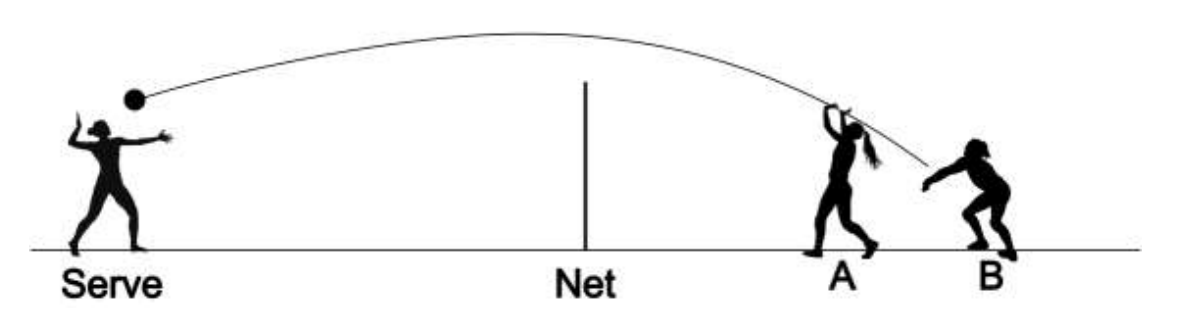
When a serve arrives at shoulder height, should your athlete use an overhead pass or a forearm pass? The common coaching answer is often based on ball height. But the decision is more complicated, and more interesting, than that.
Watch the Experiment
The video below shows the virtual-reality task used in my doctoral research. Players watched serves approach at different heights and responded by simulating either an overhead or underhand reception.
Ball Height Matters but It Is Not the Whole Story
For my doctoral research, I studied how volleyball players perceived their opportunities to receive serves in virtual reality. The serves varied in height, and players were asked to simulate a pass using either the overhead or underhand technique. We also measured each player’s maximum vertical reach.
As expected, higher serves generally encouraged overhead reception. Yet the choice was not explained by serve height alone. A ball at the same absolute height does not offer identical opportunities to players with different reaches, movement capabilities, experiences, and technique preferences.
In ecological psychology, these opportunities for action are called affordances. If that idea is new to you, read Affordances in Sports and How They Can Improve Your Coaching.
An Especially Interesting Difference Between Women and Men
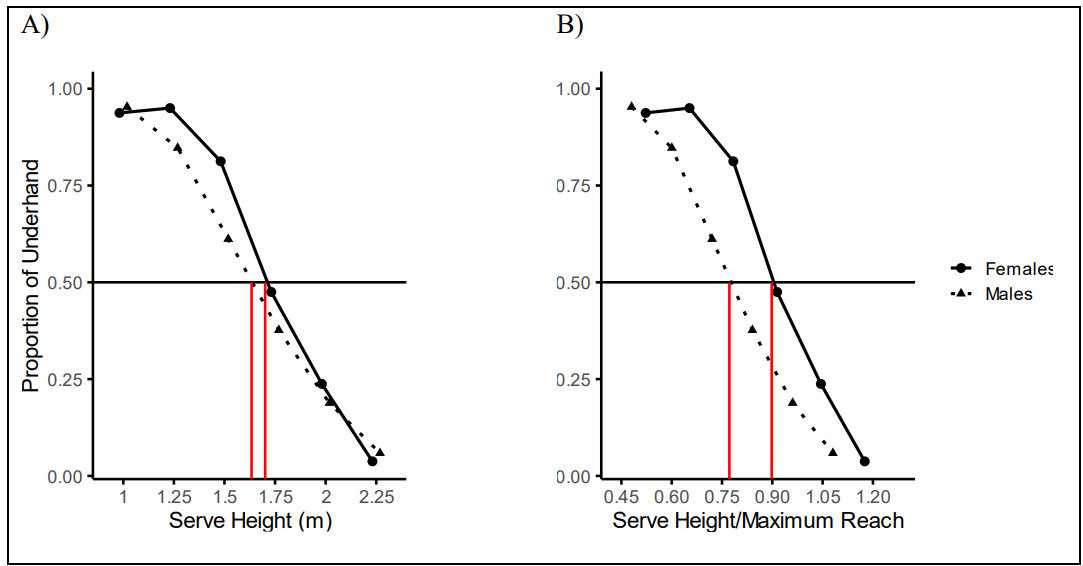
In the first experiment, female participants were generally more likely than male participants to select the underhand technique, even after accounting for ball height relative to each player’s maximum reach. This suggests that passing decisions may also reflect factors such as experience, learned preferences, and movement strategies.
Coaches sometimes suggest several possible explanations for why women’s teams may use overhead reception less often, including experience with hard-driven float serves, hand size, and finger strength. However, this study did not test those explanations directly, so they should be treated as coaching hypotheses rather than conclusions from the experiment.
Importantly, this was a group-level pattern observed under specific experimental conditions, not a rule about every woman or man. The sex-related difference became less pronounced in the second experiment, when participants were prohibited from stepping. That matters: change the task, and the preferred movement solution may change too.
What Should Coaches Do Differently?
Instead of teaching a fixed rule such as “high ball equals overhead, low ball equals underhand,” coaches should give athletes opportunities to discover when each technique works for them.
- Vary serve height and trajectory. Mix serves around each athlete’s comfortable transition zone rather than using only easy, predictable balls.
- Allow different solutions. Ask players why they chose forearms or hands and whether another option might have worked. Evaluate ball control and outcome rather than technique conformity alone.
- Manipulate movement constraints. Occasionally restrict footwork, then restore free movement. Observe how athletes adapt, but do not assume the constrained drill is automatically better.
I discuss these practice-design strategies in greater depth in Teaching Sports: An Essential Guide for Coaches and Trainers.
The Bigger Coaching Lesson
The goal is not to make every athlete choose the same technique. It is to help each athlete perceive and use the best available opportunity for action. Ball height is one part of that decision. Reach, movement, task constraints, experience, and individual tendencies are part of it too.
Read the Dissertation
Arruda, D. G. (2024). Perceiving affordances for receiving a serve in virtual volleyball (Doctoral dissertation, University of Minnesota).